

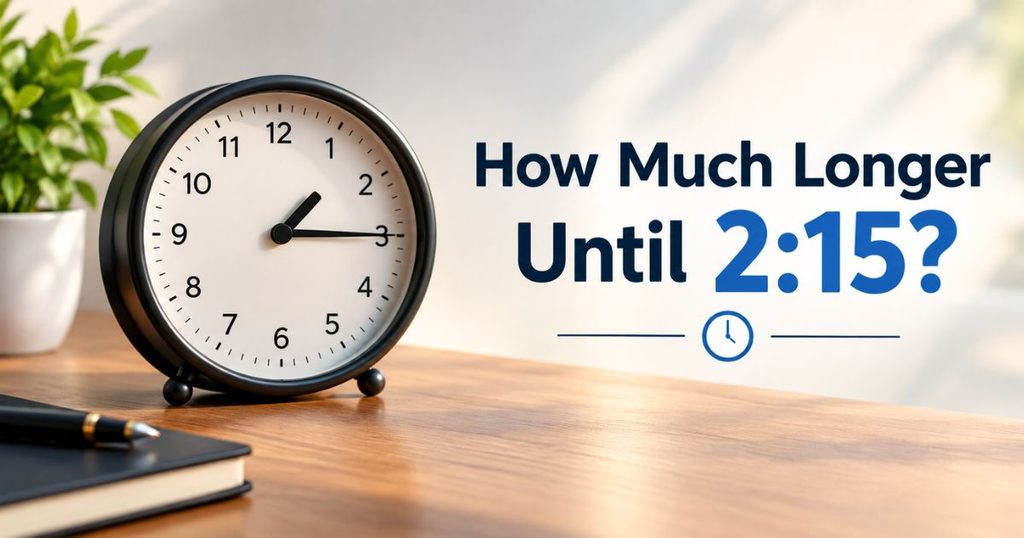
To find out how much longer until 2:15, subtract the current time from 2:15. If it’s before 2:15 today, count the hours and minutes remaining. If it’s already past 2:15, you’re counting toward 2:15 tomorrow.
Below, you’ll find simple formulas, ready-made tables, and step-by-step examples so you never have to do the math in your head again.
Time countdowns feel simple until you’re actually staring at a clock trying to figure out how many minutes are left. Maybe you’re waiting for a meeting, a bus, a movie, or just curious how far off 2:15 really is. Either way, this guide breaks the whole thing down so the answer is obvious in seconds.
The Direct Verdict: How to Know How Long Until 2:15
There’s no single fixed answer to “how much longer until 2:15” because it depends entirely on what time it is right now. That’s the honest truth. But the method to figure it out is the same every single time, and it takes under ten seconds once you know the trick.
Here’s the short version:
- Subtract your current time from 2:15.
- If the result is positive, that’s your countdown.
- If 2:15 already passed today, add 24 hours to get the countdown to 2:15 tomorrow.
- Always double-check whether you mean 2:15 AM or 2:15 PM, since mixing those up is the single most common mistake people make.
Example Countdown Table (Sample Times)
Here’s how the math plays out from a handful of common starting points. Use this as a reference pattern, then apply the same logic to your own current time.
| Current Time | Target Time | Time Remaining |
| 1:00 PM | 2:15 PM | 1 hour 15 minutes |
| 1:45 PM | 2:15 PM | 30 minutes |
| 2:00 PM | 2:15 PM | 15 minutes |
| 2:10 PM | 2:15 PM | 5 minutes |
| 12:15 PM | 2:15 PM | 2 hours |
| 11:00 AM | 2:15 PM | 3 hours 15 minutes |
| 2:20 PM | 2:15 PM (tomorrow) | 23 hours 55 minutes |
Notice the pattern: as long as you’re before 2:15, the math is a straightforward subtraction. Once you cross 2:15, you’re really counting toward the next occurrence of it.
Step-by-Step: How to Calculate Time Until 2:15
If you want to work this out manually instead of relying on a clock or app, here’s the process broken into clean steps.
Step 1: Note the current time
Write it down in the same format you’ll use for 2:15 — either 12-hour (AM/PM) or 24-hour. Mixing formats is where most errors start.
Step 2: Convert both times to minutes past midnight
This makes subtraction painless. Multiply the hour by 60, then add the minutes.
For example, 1:45 PM becomes: (13 × 60) + 45 = 825 minutes. And 2:15 PM becomes: (14 × 60) + 15 = 855 minutes.
Step 3: Subtract current time from target time
855 − 825 = 30 minutes. That’s your countdown.
Step 4: Convert back to hours and minutes if needed
If your result is over 60, divide by 60 to get hours, and the remainder is minutes. For instance, 195 minutes becomes 3 hours 15 minutes (195 ÷ 60 = 3, remainder 15).
Step 5: Handle the “already past 2:15” case
If your subtraction gives a negative number, add 1440 (the number of minutes in a full day) to get the countdown to 2:15 the next day.
Formula Breakdown Table
| Scenario | Formula | Result Type |
| Before 2:15 today | (2:15 in minutes) − (current time in minutes) | Minutes until 2:15 today |
| Exactly 2:15 | Difference = 0 | It’s happening now |
| After 2:15 today | 1440 − (current time in minutes) + (2:15 in minutes) | Minutes until 2:15 tomorrow |
| Converting minutes to hours | Total minutes ÷ 60 | Whole hours + remainder minutes |
Common Mistakes People Make With Time Countdowns
Small mix-ups cause most of the confusion here, and they’re worth calling out directly.
- Confusing AM and PM. “2:15” without a label is ambiguous. Always clarify which one you mean before doing the math.
- Forgetting to cross midnight correctly. If the countdown spans midnight, you can’t just subtract normally — you need to add the full 24-hour cycle.
- Using inconsistent time formats. Trying to subtract “14:15” from “1:45 PM” without converting first leads to wrong answers almost every time.
- Rounding too early. If you round minutes before finishing the calculation, small errors stack up. Do the full conversion first, then round at the end if needed.
- Assuming a countdown timer and a clock always agree. Device clocks can drift by a few seconds, especially on older phones or unsynced computers, which matters if you need precision down to the second.
Why People Search “How Much Longer Until 2:15”
This kind of query shows up constantly, and it’s rarely idle curiosity. A few real reasons people look this up:
- They have an appointment, flight, or meeting scheduled for 2:15 and want a live countdown.
- They’re timing something in the kitchen, at work, or during a workout and 2:15 is the cutoff.
- Kids and students often search variations of this near the end of a school day when 2:15 marks dismissal or a specific class period.
- Parents track pickup times, and 2:15 is a common school release slot in several districts.
- People streaming events, watching sports, or waiting on a livestream that starts at 2:15 want a fast gut check on how long is left.
Interestingly, searches like this spike heavily around lunchtime and early afternoon hours, since 2:15 PM sits right in that window where people are already watching the clock for the rest of their workday.
Real-World Application Scenarios
| Situation | Why 2:15 Matters | What to Do |
| Doctor’s appointment at 2:15 PM | Avoid arriving late or too early | Set a phone alarm 20-30 minutes before |
| School pickup at 2:15 PM | Traffic timing near the school | Leave 10-15 minutes early depending on distance |
| Cooking timer ending at 2:15 | Food precision matters | Use a countdown timer instead of manual tracking |
| Meeting starting at 2:15 PM | Professional punctuality | Set a calendar reminder 5-10 minutes prior |
| Live event or stream at 2:15 | Don’t miss the opening | Bookmark the countdown or set a notification |
Related Time Calculations Worth Knowing
Once you’re comfortable with this kind of math, a few related calculations come in handy:
- How many minutes until a specific time — same method, just swap the target.
- How many hours between two times — subtract the earlier time from the later one, converting to minutes first if they’re not on the hour.
- Elapsed time calculations — useful for tracking how long a task or event has been running, using the same minutes-past-midnight trick in reverse.
- Time zone conversions — if 2:15 refers to a different time zone than yours, you’ll need to adjust before running any of the formulas above.
- 24-hour to 12-hour conversions — helpful when switching between military time and standard clock time for these calculations.
Frequently Asked Questions
How do I quickly find out how much longer until 2:15 PM?
Subtract your current time (converted to minutes past midnight) from 855 minutes, which is 2:15 PM. The result, converted back to hours and minutes, is your countdown.
What if it’s already past 2:15 today?
You’re counting toward 2:15 tomorrow. Add 1440 minutes (24 hours) to the target time before subtracting your current time, or simply calculate how many minutes remain until midnight and add that to the minutes from midnight to 2:15.
Is 2:15 usually AM or PM in these searches?
It depends on context, but most searches lean toward 2:15 PM since it falls in the middle of a typical workday, school day, or afternoon schedule. Always confirm which one applies to your situation.
Can I set an automatic countdown to 2:15 instead of calculating manually?
Yes. Most phones and computers let you set a timer or alarm for a specific clock time rather than a duration, which removes the need for manual math entirely.
Why does my countdown app show a different result than my manual calculation?
This usually happens due to time zone settings, device clock drift, or a mismatch between AM and PM. Double-check your device’s time zone and format settings if the numbers don’t match.
Conclusion
Figuring out how much longer until 2:15 really comes down to one thing: knowing your current time and doing a clean subtraction. Convert both times into minutes past midnight, subtract, and convert back if needed.
Watch out for AM/PM mix-ups and midnight crossovers, since those are where most people trip up. Once you’ve got the formula down, this kind of countdown takes seconds, whether you’re tracking a meeting, a pickup time, or just watching the clock tick toward 2:15.