


You glanced at the clock, saw it wasn’t 4:30 yet, and now you’re here. Maybe you’re clocking out of work, waiting for a pickup, counting down to a show, or just bored and curious.
Whatever the reason, this guide breaks down exactly how to figure out how long until 4:30, whether that’s 4:30 AM or 4:30 PM, no matter what time it is right now.
Quick Answer
The time remaining until 4:30 depends entirely on your current time. Here’s the fast version:
- Subtract your current time from 4:30 (in the same AM/PM period), or
- If 4:30 has already passed today, count forward to 4:30 the next day
- Use the formula: Time Until 4:30 = 4:30 − Current Time (add 24 hours if the result is negative)
There’s no single fixed answer — it shifts every minute — but the math behind it takes about ten seconds once you know the trick.
How to Calculate Time Until 4:30 (Step-by-Step)
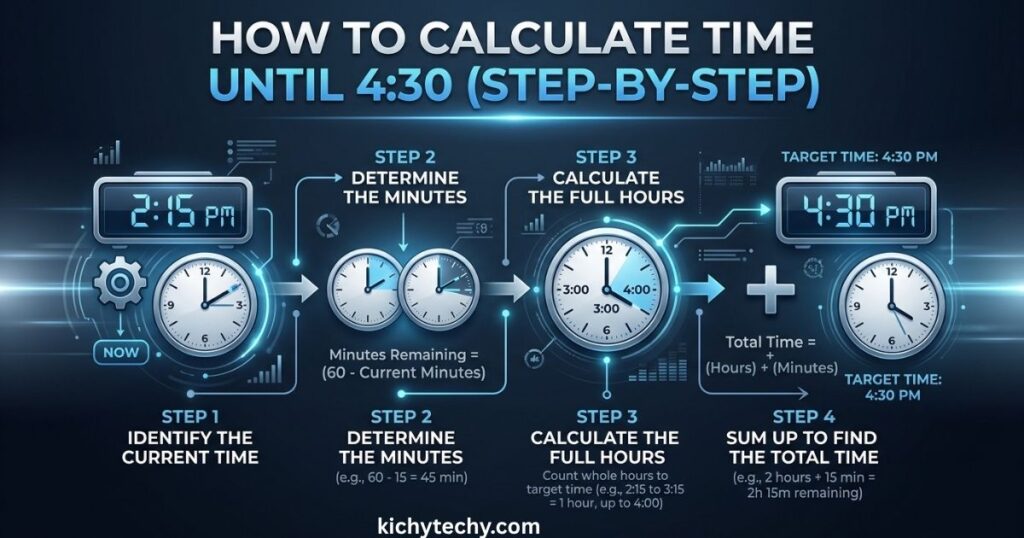
Here’s the method, broken into plain steps.
Step 1: Check the Current Time
Look at your clock or phone. Note the hour and minute, and whether it’s AM or PM.
Step 2: Decide Which 4:30 You Mean
There are two possible targets:
- 4:30 AM — early morning
- 4:30 PM — mid-afternoon
If you don’t specify, most people mean the next upcoming 4:30, whichever comes first.
Step 3: Subtract Current Time From 4:30
Convert both times to a 24-hour format if it helps avoid confusion. Then subtract.
Example: It’s currently 1:15 PM (13:15), and you want to know how long until 4:30 PM (16:30).
16:30 – 13:15 = 3 hours 15 minutes
Step 4: Adjust If 4:30 Has Already Passed

If the current time is later than 4:30 in that AM/PM period, you’re counting toward tomorrow’s 4:30. Just add 24 hours to your target before subtracting.
Example: It’s 6:00 PM and you want to know how long until 4:30 PM. Since that already passed today, you’re really asking about tomorrow:
24:00 (midnight) + 16:30 – 18:00 = 22 hours 30 minutes
Step 5: Double-Check With Minutes, Not Just Hours
A common slip-up is rounding to the nearest hour. If it’s 3:47, the gap to 4:30 isn’t “about half an hour” — it’s exactly 43 minutes. Precision matters more than people think, especially when you’re timing something like a bus, a meeting, or medication.
Time Remaining Until 4:30 PM — Common Scenarios
Here’s a table showing how much time is left until 4:30 PM, based on common current times people search for.
| Current Time | Time Until 4:30 PM |
| 12:00 PM (Noon) | 4 hours 30 minutes |
| 1:00 PM | 3 hours 30 minutes |
| 1:30 PM | 3 hours |
| 2:00 PM | 2 hours 30 minutes |
| 2:45 PM | 1 hour 45 minutes |
| 3:00 PM | 1 hour 30 minutes |
| 3:15 PM | 1 hour 15 minutes |
| 3:45 PM | 45 minutes |
| 4:00 PM | 30 minutes |
| 4:15 PM | 15 minutes |
| 4:29 PM | 1 minute |
Time Remaining Until 4:30 AM — Common Scenarios
If you’re an early riser (or a night owl still awake), here’s the same breakdown for 4:30 AM.
| Current Time | Time Until 4:30 AM |
| 12:00 AM (Midnight) | 4 hours 30 minutes |
| 1:00 AM | 3 hours 30 minutes |
| 2:00 AM | 2 hours 30 minutes |
| 2:30 AM | 2 hours |
| 3:00 AM | 1 hour 30 minutes |
| 3:45 AM | 45 minutes |
| 4:00 AM | 30 minutes |
| 4:15 AM | 15 minutes |
| 10:00 PM (previous night) | 6 hours 30 minutes |
| 11:30 PM (previous night) | 5 hours |
Formula Breakdown: Converting Time Gaps Into Different Units
Sometimes “hours and minutes” isn’t the format you need. Maybe you want minutes only, or a decimal hour value for a spreadsheet. Here’s how the conversions work.
| Format Needed | Formula | Example (3 hrs 15 min) |
| Total Minutes | Hours × 60 + Minutes | 3×60 + 15 = 195 minutes |
| Decimal Hours | Hours + (Minutes ÷ 60) | 3 + (15÷60) = 3.25 hours |
| Total Seconds | Total Minutes × 60 | 195 × 60 = 11,700 seconds |
This kind of conversion comes up a lot in scheduling apps, invoicing (billing by the hour), and countdown timers that need a raw number instead of a clock-style readout.
Real-World Situations Where This Question Comes Up
People don’t search “how long until 4:30” out of idle curiosity most of the time. It’s usually tied to something specific:
- Work shifts — counting down to clock-out time
- School dismissal — parents timing school pickup
- Appointments — a dentist, doctor, or meeting scheduled for 4:30
- Live events — a show, game, or stream starting at 4:30
- Cooking or baking — a timer set relative to a 4:30 finish time
- Fasting windows — tracking when an eating or fasting period ends
- Flights and transit — a departure or arrival at 4:30
Each of these has the exact same math underneath, just a different reason for asking.
Common Mistakes People Make When Calculating This
A few small errors trip people up constantly. Watch out for these:
Confusing AM and PM. This is the single biggest mistake. If someone means 4:30 AM but calculates against 4:30 PM, the answer is off by a full 12 hours.
Forgetting to roll over past midnight. If it’s 11:00 PM and the target is 4:30 AM, you can’t just subtract — you have to count through midnight.
Rounding too early. Saying “about an hour” when it’s actually 52 minutes might not matter for a coffee break, but it matters a lot if you’re catching a train.
Ignoring time zones. If you’re coordinating with someone in a different time zone, “4:30” means something different depending on whose clock you’re using. Always clarify whose local time you mean.
Mixing 12-hour and 24-hour formats mid-calculation. Stick to one format (either 12-hour with AM/PM, or 24-hour military time) for the whole calculation to avoid errors.
Why People Search This Topic
It seems like a simple question, but it’s genuinely one of the most common time-related searches out there — right alongside “how many days until [date]” and “what time is it in [city].” A few reasons this keeps trending:
- People are impatient near the end of a shift or school day, and manually calculating feels like extra effort
- Mobile searches spike because typing a quick question is faster than opening a calculator or countdown app
- It’s often asked in the middle of doing something else — cooking, driving, working — where a fast mental shortcut is genuinely useful
- Countdown-style searches (how long until X) tend to happen impulsively, right when the thought crosses someone’s mind
Basically, it’s less about math and more about wanting an instant, no-effort answer.
Related Calculations You Might Also Need
If you found this useful, here are a few nearby calculations that follow the same logic:
- How long until 5:00 — same method, different target time
- How many hours are in a workday — useful for shift planning
- How long until midnight — a special case since it always ends at 12:00 AM
- Time zone conversions — for coordinating across cities or countries
- Countdown to a specific date — same subtraction logic, just with days instead of hours
The underlying formula stays the same across all of these: figure out your starting point, figure out your target, and subtract.
Conclusion
Figuring out how long until 4:30 really comes down to one simple subtraction: your current time subtracted from 4:30, adjusted for AM/PM and rolled over to the next day if needed.
It sounds small, but knowing the shortcut saves you from squinting at a clock and doing awkward mental math under pressure, especially when you’re counting down to something that actually matters, like a shift ending or an appointment starting.
Once you’ve got the formula down, you’ll never need to search it again, you’ll just glance at the clock and know.
Frequently Asked Questions
How do I quickly calculate how long until 4:30 without a calculator?
Round the current time to the nearest 15-minute mark, subtract from 4:30 in your head using quarter-hour chunks, then adjust with the exact minutes. Most people can do this in under 10 seconds with practice.
Does “how long until 4:30” mean AM or PM?
It depends on context. If no AM/PM is specified, most calculators and apps default to whichever 4:30 comes next — so if it’s currently 2:00 PM, it means 4:30 PM; if it’s 5:00 AM, it usually still means 4:30 PM later that day, not the one that already passed.
What if it’s already past 4:30 today?
Then you’re counting toward 4:30 the next day. Add 24 hours to the target time before subtracting your current time, or just count forward through midnight.
How many minutes are there between 12:00 PM and 4:30 PM?
There are exactly 270 minutes between 12:00 PM and 4:30 PM, which equals 4 hours and 30 minutes.
Can time zone differences change the answer to how long until 4:30?
Yes. If you’re coordinating with someone in another time zone, “4:30” refers to a different actual moment depending on whose local clock is being used. Always confirm which time zone the 4:30 target is set in before calculating.