

You glanced at the clock, saw an appointment, alarm, or event set for 3:10, and now you want a straight answer: how much time is actually left? No fluff, no complicated conversions — just the number of hours and minutes standing between now and 3:10.
This guide walks you through exactly how to figure that out, whether you’re counting down to 3:10 AM or 3:10 PM, and gives you the formulas, tables, and shortcuts so you never have to second-guess your mental math again.
Quick Answer
The time left until 3:10 depends entirely on your current time, since “how long until 3:10” is a moving target that changes every minute. Here’s the fast method:
Subtract your current time from 3:10. If the current time is later than 3:10 in the same 12-hour cycle, you’re counting to the next occurrence of 3:10 (add 12 or 24 hours as needed).
For example, if it’s currently 1:45 PM and you’re counting to 3:10 PM, that’s 1 hour and 25 minutes away. If it’s currently 5:00 PM and you’re counting to 3:10 AM the next day, that’s 10 hours and 10 minutes away.
There’s no single fixed answer — but the math behind it is dead simple once you see the pattern below.
Why “How Long Until 3:10” Is Actually Two Questions
Before you calculate anything, you need to nail down one detail: are you asking about 3:10 AM or 3:10 PM? People often type this search without specifying, but the answer changes drastically depending on which one you mean.
- 3:10 AM — early morning, typically associated with alarms, red-eye flights, or late-night shift changes.
- 3:10 PM — mid-afternoon, usually tied to meetings, school pickup, appointments, or end-of-workday countdowns.
If you don’t specify AM or PM, most calculators (and most people doing this in their head) default to the next upcoming 3:10, whichever comes first on the clock.
Step-by-Step: How to Calculate Time Until 3:10
Here’s the exact process, broken into simple steps you can do without a calculator.
Step 1: Note your current time
Look at your device or watch and write down the current hour and minute. Let’s say it’s currently 11:42 AM.
Step 2: Identify your target (3:10 AM or 3:10 PM)

Decide which 3:10 you’re counting toward. For this example, let’s use 3:10 PM.
Step 3: Subtract hours first, then minutes
Break the subtraction into two parts instead of doing it all at once — it’s far less error-prone.
- Hours: 3 PM − 11 AM = a difference you’ll refine with minutes
- Minutes: 10 minutes − 42 minutes (this will require “borrowing” an hour)
Step 4: Borrow an hour if minutes go negative
Since 42 minutes is more than 10 minutes, borrow 60 minutes from the hour column:
- 3:10 PM becomes 2:70 PM (temporarily, for calculation purposes)
- 2:70 PM − 11:42 AM = 3 hours and 28 minutes
Step 5: Double-check with total minutes
For accuracy, convert both times into minutes since midnight and subtract:
- 3:10 PM = 15 hours × 60 + 10 = 910 minutes
- 11:42 AM = 11 × 60 + 42 = 702 minutes
- 910 − 702 = 208 minutes, which equals 3 hours and 28 minutes
Both methods match, so you know the answer is solid.
Example Calculations Table
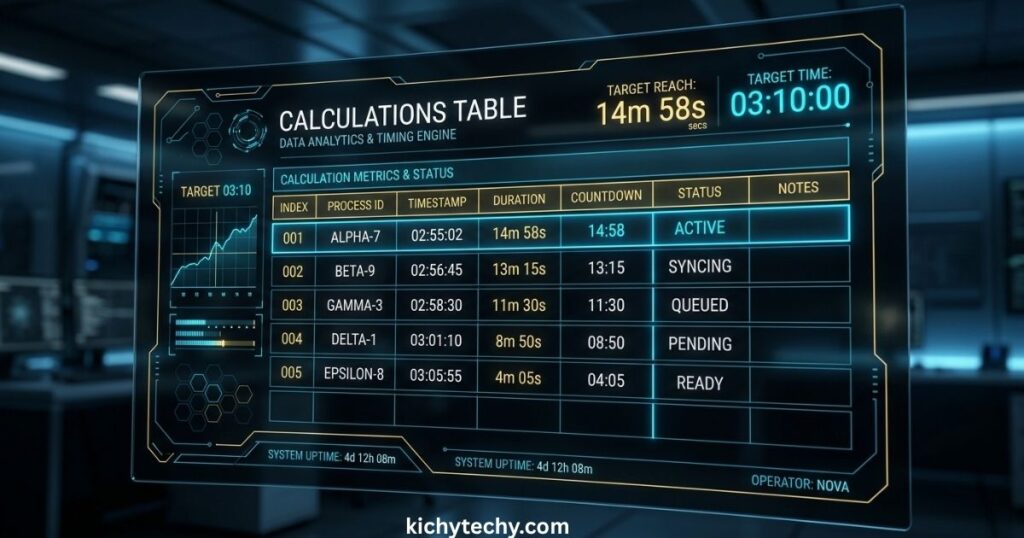
Here are several common scenarios so you can find one close to your situation and adjust.
| Current Time | Target Time | Time Remaining |
| 1:00 PM | 3:10 PM | 2 hours 10 minutes |
| 2:45 PM | 3:10 PM | 25 minutes |
| 3:00 PM | 3:10 PM | 10 minutes |
| 9:30 AM | 3:10 PM | 5 hours 40 minutes |
| 11:42 AM | 3:10 PM | 3 hours 28 minutes |
| 6:00 PM | 3:10 AM (next day) | 9 hours 10 minutes |
| 10:15 PM | 3:10 AM (next day) | 4 hours 55 minutes |
| 12:01 AM | 3:10 AM | 3 hours 9 minutes |
Converting Minutes to a Decimal Format
Sometimes you don’t want the answer in hours-and-minutes format — you want a decimal, especially if you’re logging time for work, billing, or a spreadsheet. Here’s how minutes convert to decimal hours:
| Minutes | Decimal Hours |
| 10 | 0.17 |
| 15 | 0.25 |
| 20 | 0.33 |
| 25 | 0.42 |
| 30 | 0.50 |
| 40 | 0.67 |
| 45 | 0.75 |
| 50 | 0.83 |
So “3 hours and 28 minutes” becomes roughly 3.47 hours in decimal form. The formula is simple: divide the minutes by 60, then add that to the whole hour count.
Real-World Scenarios Where This Question Comes Up
People don’t ask “how long until 3:10” out of idle curiosity — it’s almost always tied to something specific. Here are the most common triggers:
Catching a flight or train. If your boarding time or departure is 3:10 PM, you’re mentally counting down to know when to leave for the airport or station.
A scheduled call or meeting. Someone tells you “let’s talk at 3:10” and you immediately want to know how much prep time you have.
An alarm set for 3:10 AM. Maybe you’re catching an early flight, starting a night shift, or just trying to figure out how many hours of sleep you’ll actually get.
A countdown for kids or school pickup. Parents often calculate this exact kind of window when planning errands around pickup times.
Cooking or baking with a timer ending at 3:10. Less common, but it happens — especially with slow cookers or oven timers set to finish at a specific clock time rather than a duration.
Common Mistakes People Make With This Calculation
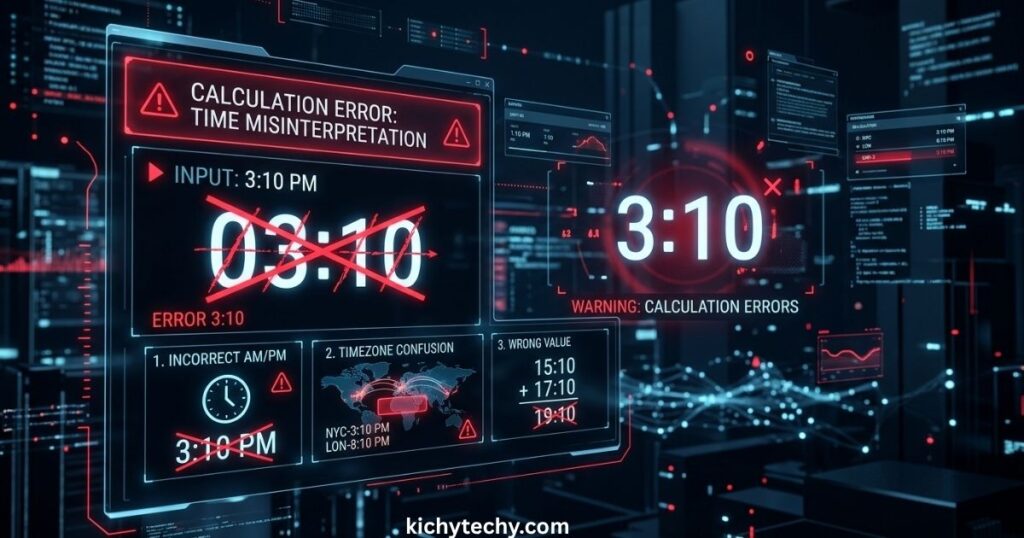
Even a simple subtraction like this trips people up more often than you’d expect. Here’s where it goes wrong:
- Forgetting AM vs PM entirely. This is the single biggest error. Always confirm which 3:10 you mean before doing any math.
- Subtracting minutes without borrowing correctly. If your current minutes are higher than 10 (the target’s minute value), you need to borrow an hour, not just get a negative number and ignore it.
- Ignoring the date rollover. If it’s 9 PM and you’re counting to 3:10 AM, remember that’s the next day, not later today.
- Rounding too early. If you round 3 hours 28 minutes down to “about 3 and a half hours” before finalizing other calculations, small errors compound.
- Mixing 12-hour and 24-hour formats. If you’re working with a 24-hour clock (military time), 3:10 PM is 15:10 — don’t accidentally subtract from 03:10 instead.
Why People Search This Topic
Time-until questions like this one spike constantly across search engines, and it’s not because people can’t do math. It’s because doing quick mental subtraction under time pressure — while getting ready, rushing to leave, or juggling a dozen other tasks — is genuinely easy to mess up. A fast, reliable answer beats fumbling with your own arithmetic when you’re already stressed about being on time.
There’s also the AM/PM ambiguity problem. Typing “how long until 3:10” into a search bar is often faster than opening a calculator app and manually figuring out which 3:10 applies to your situation.
Related Calculations and Topics
If this kind of time math is useful to you, here are a few related calculations worth knowing:
- How long until midnight — useful for New Year’s countdowns or deadline tracking.
- How many hours between two times — the general version of this same subtraction method.
- Converting 12-hour time to 24-hour time — helpful for travel, military schedules, or international coordination.
- Time zone difference calculators — for when “3:10” refers to a different zone than the one you’re in.
- Countdown to a specific date and time — combines both date and time math for events further out.
Conclusion
Figuring out how long until 3:10 comes down to one thing: knowing your current time and subtracting carefully, with attention to AM versus PM and whether you need to borrow an hour.
Once you get the method down — hours first, then minutes, double-checked with total minutes since midnight — you can do this calculation in your head in seconds, no app required.
Frequently Asked Questions
How do I know if 3:10 means AM or PM?
Context usually tells you. If you’re planning something for later today and it’s already past noon, it’s almost certainly 3:10 PM. If you’re dealing with an early morning event, alarm, or overnight schedule, it’s 3:10 AM. When in doubt, check whichever 3:10 comes next on the clock from your current time.
What if it’s already past 3:10 today?
Then you’re counting to 3:10 tomorrow, not today. Add 24 hours to your target time before subtracting, or simply calculate the time remaining until midnight and add that to the hours from midnight to 3:10 the next day.
Is there a quick mental shortcut instead of full subtraction?
Yes. Round your current time to the nearest 5 or 10 minutes, do the subtraction with the rounded number, then adjust by the few minutes you rounded off. It’s faster and still accurate enough for everyday use.
How many minutes are there between now and 3:10 if I only have the hour?
Multiply the difference in hours by 60, then adjust for the minute value of your current time versus 10 minutes past the target hour. For example, going from 1:00 PM to 3:10 PM is 2 full hours (120 minutes) plus 10 more minutes, totaling 130 minutes.
Does this calculation change with daylight saving time?
Yes, on the specific days when clocks shift forward or back. If the clock change falls between your current time and 3:10, you’ll need to add or subtract an extra hour depending on which direction the shift goes. On any normal day, this doesn’t affect the calculation at all.