

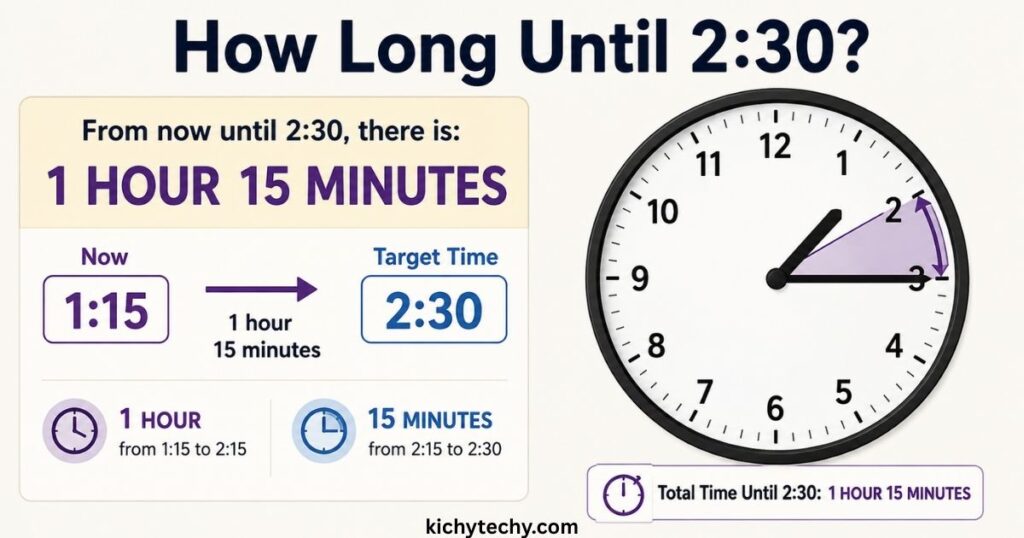
Ever caught yourself staring at the clock, mentally doing math, trying to figure out how long until 2:30? Maybe you’ve got a meeting at that time, a flight to catch, or you’re just counting down to the end of your shift. Whatever the reason, this guide walks you through exactly how to calculate it, no matter what time it is right now.
Quick Answer
The time left until 2:30 depends entirely on the current time when you’re asking. Since there’s no fixed “now,” here’s the fastest way to get your answer:
- Check the current time on your phone, computer, or watch.
- Subtract it from 2:30 (either 2:30 AM or 2:30 PM, depending on which one is next).
- If the current time is already past 2:30 today, count forward to 2:30 the next day.
If you want an instant, error-free answer, just type “how long until 2:30” into Google or your phone’s search bar, and it’ll calculate it live based on your device’s clock. But if you want to understand the actual math behind it (which is genuinely useful for planning your day), keep reading.
Why the Answer Changes Every Time

Unlike asking “how many days in a year” or “how many minutes in an hour,” this question doesn’t have one fixed answer. It’s a moving target because it depends on:
- The exact moment you’re asking
- Whether you mean 2:30 AM or 2:30 PM
- Your time zone
- Whether 2:30 has already passed today (in which case you’re really asking about tomorrow)
That’s why search engines and countdown tools always ask for (or auto-detect) your current time before spitting out a number.
Step-by-Step: How to Calculate It Yourself
Here’s the manual method, broken into simple steps. Grab the current time and follow along.
Step 1: Confirm the Current Time
Look at a reliable clock — your phone is usually the most accurate since it syncs with network time. Note the hour and minute.
Step 2: Decide Which 2:30 You Mean

- If it’s currently morning or early afternoon, you probably mean 2:30 PM (afternoon).
- If it’s evening or night, you probably mean 2:30 AM (the next day).
Step 3: Subtract Current Time From Target Time
Convert both times to a 24-hour format to avoid AM/PM confusion, then subtract.
Example: It’s currently 11:15 AM, and you want to know how long until 2:30 PM.
- 2:30 PM = 14:30
- 11:15 AM = 11:15
- 14:30 − 11:15 = 3 hours 15 minutes
Step 4: Adjust for Crossing Midnight
If your current time is after 2:30 PM but before midnight, and you’re aiming for 2:30 AM the next day, add 24 hours to the target time before subtracting.
Example: It’s currently 9:00 PM, and you want 2:30 AM tomorrow.
- 2:30 AM tomorrow = 26:30 (24:00 + 2:30)
- 9:00 PM = 21:00
- 26:30 − 21:00 = 5 hours 30 minutes
Time Remaining Examples (Sample Table)
Below is a sample reference table showing how the countdown looks from different starting points. Use it as a pattern to calculate your own situation — just plug in your actual current time.
| Current Time | Target: 2:30 PM (Today) | Time Remaining |
| 8:00 AM | 2:30 PM | 6 hours 30 minutes |
| 10:45 AM | 2:30 PM | 3 hours 45 minutes |
| 12:00 PM | 2:30 PM | 2 hours 30 minutes |
| 1:15 PM | 2:30 PM | 1 hour 15 minutes |
| 2:00 PM | 2:30 PM | 30 minutes |
| 2:29 PM | 2:30 PM | 1 minute |
| Current Time | Target: 2:30 AM (Next Day) | Time Remaining |
| 6:00 PM | 2:30 AM | 8 hours 30 minutes |
| 9:30 PM | 2:30 AM | 5 hours |
| 11:45 PM | 2:30 AM | 2 hours 45 minutes |
| 1:00 AM | 2:30 AM | 1 hour 30 minutes |
| 2:15 AM | 2:30 AM | 15 minutes |
Converting the Countdown Into Other Units

Sometimes hours and minutes aren’t the format you need. Here’s how to convert a countdown into other useful units, using the “3 hours 15 minutes” example from earlier.
| Unit | Conversion | Result |
| Total Minutes | (3 × 60) + 15 | 195 minutes |
| Total Seconds | 195 × 60 | 11,700 seconds |
| Decimal Hours | 3 + (15 ÷ 60) | 3.25 hours |
| Fraction of a Day | 3.25 ÷ 24 | ~0.135 (about 13.5%) of a day |
This kind of breakdown is handy if you’re logging work hours, setting a countdown timer app, or need a precise decimal value for a spreadsheet.
Real-World Scenarios Where This Question Comes Up
People don’t usually ask “how long until 2:30” just out of curiosity. It’s almost always tied to something practical:
- Work shifts — counting down to a 2:30 PM clock-out or a 2:30 AM start time
- School dismissal — many schools let out around 2:30 PM, so parents and students track it closely
- Flight or train departures — boarding times or departure times often land near this mark
- Medication schedules — people managing dosage timing need precise countdowns
- Live events or appointments — doctor visits, webinars, or calls scheduled for 2:30
- Cooking or baking timers — less common, but some slow-cook recipes need a specific finish time
Each of these situations needs a slightly different approach, but the core math stays the same: find the gap between now and 2:30.
Common Mistakes People Make
Even a simple time calculation trips people up more often than you’d expect. Here are the usual culprits:
- Mixing up AM and PM. This is the single biggest error. Always double-check which 2:30 you’re targeting before doing the math.
- Forgetting time zones. If you’re coordinating with someone in a different region, “2:30” in their world might not match yours at all.
- Not accounting for daylight saving changes. During the “spring forward” or “fall back” transition, a straightforward subtraction can be off by an hour.
- Ignoring the date rollover. If it’s currently 11:00 PM and you want 2:30 AM, remember you’re crossing into a new day — treat it as 26:30, not 2:30, when subtracting.
- Rounding too early. If you round 3 hours 47 minutes down to “about 4 hours” too soon, small errors compound if you’re stacking multiple calculations.
Why People Search This Topic
This might seem like a strange thing to type into a search bar, but it’s actually one of the most common “quick check” queries out there. A few reasons why:
- It’s faster than doing mental math, especially when you’re tired, busy, or multitasking.
- People trust the search engine’s live clock more than their own guess.
- It works great as a voice search — asking a smart speaker is easier than calculating manually while your hands are full.
- It’s often tied to anxiety or anticipation — waiting for a call, a flight, or an event makes people check obsessively.
Search engines have gotten good at recognizing these “how long until [time]” queries and answering them instantly using your device’s local clock, which is why this phrase shows up in autocomplete so often.
Related Calculations and Topics
If this kind of time math is useful to you, here are a few related calculations worth knowing:
- How long until midnight — useful for New Year’s countdowns or late-night deadlines
- How many hours until a specific date — for trip planning or event countdowns
- Time zone converters — for scheduling calls across regions
- Elapsed time calculators — for figuring out how much time has passed between two points
- Work hour calculators — for tracking shift lengths and overtime
Bookmarking a reliable time calculator or countdown app can save you from redoing this math every single day.
Conclusion
Figuring out how long until 2:30 really comes down to one simple subtraction: target time minus current time, adjusted for AM/PM and whether you’re crossing into a new day. Once you know the trick — converting to 24-hour format and watching out for midnight rollovers — you’ll never second-guess yourself again.
Whether you’re counting down to a meeting, a shift, or just watching the clock, the math takes seconds once you know the pattern.
Frequently Asked Questions
How do I find out how long until 2:30 right now?
Check your current time, then subtract it from 2:30 (using 24-hour format to avoid AM/PM mix-ups). If you’d rather skip the math, typing the question into a search engine gives you an instant, live answer.
Does “2:30” usually mean AM or PM?
It depends on context. If you’re asking during the morning or early afternoon, it’s almost always 2:30 PM. If you’re asking late at night, it’s usually 2:30 AM the next day.
How many minutes are there between now and 2:30?
Multiply the hour difference by 60, then add any remaining minutes. For example, 2 hours 30 minutes equals 150 minutes total.
What if 2:30 has already passed today?
Then you’re counting toward 2:30 tomorrow. Add 24 hours to the target time before subtracting, so you don’t end up with a negative number.
Why does my countdown app show a different answer than my manual calculation?
Countdown apps sync with your device’s network time, which is usually more accurate than a manually checked clock or watch. If there’s a mismatch, trust the app, and double-check your device’s time zone settings.