

You glanced at the clock, saw a meeting or an appointment set for 2:20, and now you’re doing that mental math thing we all do — squinting at the minute hand, muttering “okay so that’s… how long?” You’re not alone. This is one of the most common quick-math questions people type into Google, right up there with “how many days until Friday” or “what time is it in 6 hours.”
This guide walks you through exactly how to calculate the time remaining until 2:20, whether that’s 2:20 AM or 2:20 PM, gives you ready-made reference tables for common current times, and clears up the small mistakes that trip people up (looking at you, AM/PM mix-ups).
Quick Answer
There’s no single fixed answer to “how long until 2:20” because it depends entirely on what time it is right now when you’re asking. The calculation itself, though, is dead simple:
Time remaining = 2:20 − Current time
If it’s currently earlier than 2:20 on the clock, you just subtract. If it’s already past 2:20, you add the hours left until midnight, then add the hours from midnight to 2:20 the next day. That’s it — the whole trick is in that second scenario, and we’ll break it down step by step below.
A Simple Table: Time Left Until 2:20 PM
Here’s a fast-reference table if you’re counting down to 2:20 PM (14:20) today:
| Current Time | Time Until 2:20 PM |
| 9:00 AM | 5 hours 20 minutes |
| 10:00 AM | 4 hours 20 minutes |
| 11:00 AM | 3 hours 20 minutes |
| 12:00 PM (Noon) | 2 hours 20 minutes |
| 1:00 PM | 1 hour 20 minutes |
| 1:45 PM | 35 minutes |
| 2:00 PM | 20 minutes |
| 2:15 PM | 5 minutes |
| 2:20 PM | 0 minutes (it’s now!) |
A Simple Table: Time Left Until 2:20 AM
If you’re counting down to 2:20 AM instead, here’s your table:
| Current Time | Time Until 2:20 AM |
| 8:00 PM | 6 hours 20 minutes |
| 10:00 PM | 4 hours 20 minutes |
| 12:00 AM (Midnight) | 2 hours 20 minutes |
| 1:00 AM | 1 hour 20 minutes |
| 1:50 AM | 30 minutes |
| 2:00 AM | 20 minutes |
| 2:20 AM | 0 minutes (it’s now!) |
Notice the pattern: whether you’re counting toward the AM or PM version of 2:20, the math logic stays the same. The only thing that changes is whether you cross midnight in your calculation.
How to Calculate Time Until 2:20, Step by Step
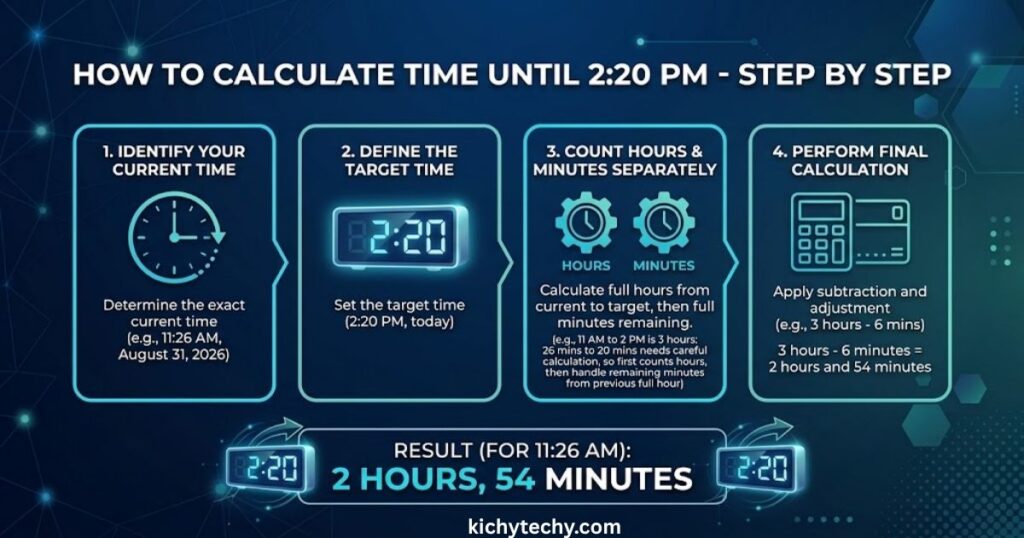
If you want to figure this out yourself without a calculator or app, follow this process. It works for any target time, not just 2:20.
Step 1: Confirm Which 2:20 You Mean
This sounds obvious, but it’s the number one source of confusion. Is your appointment at 2:20 AM (the middle of the night) or 2:20 PM (early afternoon)? Check your calendar invite, text message, or ticket confirmation. If it just says “2:20” with no AM/PM, assume it’s during normal waking hours unless context says otherwise.
Step 2: Convert Everything to 24-Hour Format (Optional but Helpful)
Military time removes the AM/PM guesswork entirely.
- 2:20 AM = 02:20
- 2:20 PM = 14:20
If your current time is, say, 11:40 AM, that’s 11:40 in 24-hour format. Now you’re just subtracting two numbers on the same scale.
Step 3: Subtract Current Time from Target Time
Take your target time and subtract the current time:
Example: Current time is 12:50 PM (12:50), target is 2:20 PM (14:20).
- Hours: 14 − 12 = 2 hours
- Minutes: 20 − 50 = -30 minutes (this is negative, so borrow an hour)
- Borrow 1 hour from the hours total: 2 hours becomes 1 hour, and -30 minutes becomes 30 minutes
Result: 1 hour 30 minutes until 2:20 PM.
Step 4: Handle the “Past Midnight” Case
If your target time (2:20) is technically earlier in the clock than your current time, you’re crossing into the next day. Here’s how:
- Calculate time remaining until midnight (24:00).
- Add the time from midnight to 2:20 (which is always 2 hours 20 minutes, since 2:20 AM is 2 hours 20 minutes after midnight).
Example: It’s currently 6:00 PM (18:00), and you want to know how long until 2:20 AM.
- Midnight minus 18:00 = 6 hours
- Add 2 hours 20 minutes (midnight to 2:20 AM)
- Total: 8 hours 20 minutes
Step 5: Double-Check with a Live Clock

The most reliable way, honestly, is to just check your phone’s current time and do the subtraction fresh. Clocks drift, screenshots go stale, and “right now” changes by the second — so always calculate from the actual current time, not a number you saw five minutes ago.
Real-World Scenarios Where This Question Comes Up
People don’t search “how long until 2:20” out of idle curiosity. It’s almost always tied to something specific:
- Countdown to a meeting — You’ve got a 2:20 PM call and you’re deciding whether you have time to grab coffee first.
- Flight or train departure — Boarding or departure listed at 2:20, and you’re figuring out if you’ll make it.
- Medication timing — Some prescriptions need to be taken at specific intervals, and 2:20 might be your next dose window.
- Cooking or baking — A recipe step says “let it rest until 2:20” and you’re tracking it against the oven clock.
- Kids’ school pickup or activity end time — Practice or class wraps at 2:20 and you’re timing your drive.
- Late-night or early-morning shift changes — 2:20 AM shows up a lot in shift work, especially in hospitals, warehouses, and manufacturing.
Common Mistakes People Make With This Calculation
Mixing Up AM and PM
This is by far the most common error. Someone calculates “2 hours 20 minutes” thinking it’s 2:20 PM, when the actual appointment was 2:20 AM the next day — leading to a wildly wrong estimate. Always confirm AM/PM before you start subtracting.
Forgetting to Borrow an Hour
When the current minute count is higher than the target minute count (like our 12:50 to 14:20 example), people often just subtract straight across and get a negative number, then panic. Remember: borrow an hour, convert it to 60 minutes, and redo the subtraction.
Ignoring Time Zones
If you’re coordinating with someone in a different time zone, “2:20” means something different depending on whose clock you’re using. A 2:20 PM meeting in New York is 11:20 AM in Los Angeles. Always clarify whose local time the 2:20 refers to.
Not Accounting for Daylight Saving Time Transitions
Twice a year, clocks shift by an hour. If your countdown to 2:20 spans a DST changeover night, your simple subtraction will be off by 60 minutes. This is rare but worth remembering if you’re planning something around those specific dates.
Assuming “2:20” Always Means Today
If it’s currently 9:00 PM and someone says “meet at 2:20,” they almost certainly mean 2:20 the next afternoon, not 2:20 AM in five hours. Context clues (like “this afternoon” or “tomorrow”) matter more than the raw number.
Why People Search “How Long Until 2:20”
Time-countdown searches like this spike constantly online, and it’s not really about the number 2:20 specifically — it’s about the human habit of outsourcing quick math. Rather than count on fingers or scroll through a phone’s calculator app, people type the exact question into a search bar and expect an instant, no-fuss answer.
It also reflects how specific our daily planning has become. We’re not just asking “how long until this afternoon” anymore — we’re asking down to the exact minute, because calendars, transit apps, and smart devices have trained us to expect precision.
Related Calculations You Might Also Need
| Calculation Type | Example Question |
| Countdown to a specific time | How long until 3:45 PM? |
| Countdown to a specific date | How many days until December 25? |
| Elapsed time between two clock times | How much time passed between 9:15 AM and 2:20 PM? |
| Time zone conversion | What is 2:20 PM EST in PST? |
| Adding/subtracting hours | What time is it 5 hours from now? |
| Countdown to an event | How long until New Year’s Eve? |
If you found this guide useful, these related questions follow the exact same subtraction-and-borrowing logic explained above — just swap in your own numbers.
Conclusion
Figuring out how long until 2:20 really comes down to one simple subtraction: target time minus current time, with a bit of hour-borrowing if the minutes don’t line up cleanly, and an extra midnight-crossing step if your target time has already passed for the day.
Once you know whether you’re aiming for 2:20 AM or 2:20 PM, the rest is just arithmetic. Bookmark the tables above for a quick gut-check next time the question pops into your head.
Frequently Asked Questions
How do I quickly calculate how long until 2:20 PM from right now?
Subtract your current time from 14:20 (2:20 PM in 24-hour format). If the minutes don’t subtract evenly, borrow an hour and convert it to 60 minutes before finishing the calculation.
Is 2:20 in the afternoon or the morning?
“2:20” alone is ambiguous — it could be 2:20 AM (early morning) or 2:20 PM (afternoon). Always check the AM/PM label or the context of the plan to avoid confusion.
What if it’s already past 2:20 today — how long until the next one?
Calculate the time remaining until midnight, then add the time from midnight to 2:20 (which is always 2 hours and 20 minutes for the AM version). Combine both numbers for your total wait time.
Does daylight saving time affect the countdown to 2:20?
Yes, but only on the two nights per year when clocks change. If your countdown spans one of those transitions, add or subtract an hour depending on whether clocks moved forward or back.
Can I use this same method for any target time, not just 2:20?
Absolutely. The subtraction-and-borrowing method works for any clock time you’re counting down to — just replace 2:20 with your actual target time and follow the same steps.