


You glanced at the clock, saw it wasn’t 2:10 yet, and now you want the answer fast. Maybe you’ve got a meeting at 2:10, a train to catch, or you’re just curious how much of the day is left before that specific minute rolls around. Either way, you’re in the right place.
This guide breaks down exactly how to figure out how long until 2:10 — whether that’s 2:10 AM or 2:10 PM — and gives you the tools to calculate it for any current time, no calculator required.
Quick Answer
There’s no single fixed answer to “how long until 2:10,” because it depends entirely on what time it is right now. But here’s the shortcut:
Take the current time, subtract it from 2:10 (either AM or PM, whichever comes next), and you’ve got your countdown.
If it’s currently before 2:10 in that same half of the day, subtract normally. If it’s already past 2:10, you’re counting to the next 2:10 — which could be later today or tomorrow morning, depending on whether you mean AM or PM.
Why There’s No One Answer
“How long until 2:10” is one of those questions that looks simple but depends on a moving target — the present moment. Unlike asking “how many days are in a leap year,” this calculation changes every time someone asks it. That’s exactly why so many people search for it instead of just doing the math themselves: they want a fast, reliable method instead of second-guessing their own subtraction.
So instead of giving you one static number, this post gives you the actual method, worked examples, and a few tables you can use as a mental cheat sheet.
Step-by-Step: How to Calculate Time Until 2:10
Here’s the process broken into plain steps.
Step 1: Confirm AM or PM
This trips people up constantly. 2:10 AM and 2:10 PM are twelve hours apart. Before doing any math, decide which one you actually mean.
Step 2: Check the Current Time
Look at a clock or your phone. Note the hour and minute precisely — not “around 1,” but the exact reading, like 1:47.
Step 3: Subtract Minutes First
Line up the minutes. If the current minute is higher than 10 (the minute in 2:10), you’ll need to borrow an hour.
Step 4: Subtract Hours
Once minutes are sorted, subtract the hours the same way you would in basic arithmetic, borrowing across midnight or noon if needed.
Step 5: Adjust for Day Rollover
If your current time is already past 2:10 for the period you care about, add 24 hours to your target time before subtracting. That gives you the countdown to the next occurrence.
Worked Example 1: Same-Day Countdown
Let’s say it’s currently 1:35 PM, and you want to know how long until 2:10 PM.
- Minutes: 10 − 35 = need to borrow. Convert 2:10 to 1:70.
- Hours: 1 − 1 = 0
- Minutes: 70 − 35 = 35
Answer: 35 minutes.
Worked Example 2: Crossing the Hour
It’s currently 1:58 PM. How long until 2:10 PM?
- Minutes: 10 − 58, borrow again. 2:10 becomes 1:70.
- Hours: 1 − 1 = 0
- Minutes: 70 − 58 = 12
Answer: 12 minutes.
Worked Example 3: Overnight Countdown
It’s currently 11:45 PM, and you’re counting to 2:10 AM.
Since 2:10 AM is technically “tomorrow” relative to 11:45 PM, treat it as 26:10 in 24-hour terms (24:00 + 2:10).
- 26:10 − 23:45 = 2 hours 25 minutes
Answer: 2 hours and 25 minutes.
Countdown Reference Table (To 2:10 PM)
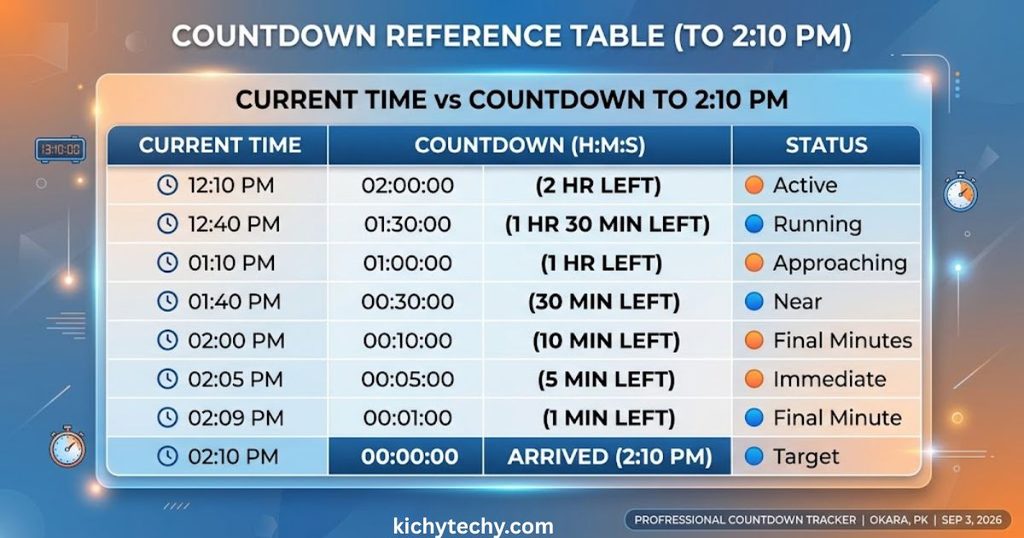
Use this table if you’re counting down to 2:10 PM today.
| Current Time | Time Until 2:10 PM |
| 12:00 PM | 2 hours 10 minutes |
| 12:30 PM | 1 hour 40 minutes |
| 1:00 PM | 1 hour 10 minutes |
| 1:15 PM | 55 minutes |
| 1:30 PM | 40 minutes |
| 1:45 PM | 25 minutes |
| 2:00 PM | 10 minutes |
| 2:05 PM | 5 minutes |
| 2:09 PM | 1 minute |
Countdown Reference Table (To 2:10 AM)
Use this one if you’re counting down to 2:10 AM — helpful for night shifts, red-eye flights, or late-night deadlines.
| Current Time | Time Until 2:10 AM |
| 10:00 PM | 4 hours 10 minutes |
| 11:00 PM | 3 hours 10 minutes |
| 12:00 AM | 2 hours 10 minutes |
| 12:30 AM | 1 hour 40 minutes |
| 1:00 AM | 1 hour 10 minutes |
| 1:45 AM | 25 minutes |
| 2:00 AM | 10 minutes |
| 2:09 AM | 1 minute |
Converting Minutes Into Other Formats
Sometimes you don’t just want minutes — you want it broken into hours, or even seconds, especially if you’re setting a timer.
| Format | Example (35 minutes until 2:10) |
| Minutes | 35 minutes |
| Hours (decimal) | 0.58 hours |
| Seconds | 2,100 seconds |
| Hours + Minutes | 0 hours, 35 minutes |
To convert minutes to decimal hours, divide by 60. So 35 minutes ÷ 60 = 0.58 hours. To get seconds, multiply minutes by 60.
Common Mistakes People Make
Mixing up AM and PM. This is the single biggest error. “2:10” without a label is ambiguous, and plenty of countdown mistakes happen because someone assumed PM when the other person meant AM.
Forgetting to borrow when subtracting minutes. If your current minute is higher than 10, you can’t just subtract straight across — you have to borrow an hour first, same as regular subtraction with numbers.
Ignoring day rollover. If it’s currently 3:00 PM and someone asks how long until 2:10, they usually mean tomorrow’s 2:10, not one that already passed. Skipping this step gives you a negative number that makes no sense.
Using 24-hour and 12-hour time inconsistently. Mixing military time with standard time mid-calculation is a fast way to get the wrong answer. Pick one format and stick with it for the whole calculation.
Rounding too early. If you round “12 minutes and 40 seconds” down to “12 minutes” before finishing other math, small errors stack up. Keep full precision until the final step.
Why People Search “How Long Until 2:10”
This kind of query is more common than it might seem, and it usually falls into one of a few categories:
- Meetings and appointments — someone has a call or appointment scheduled for 2:10 and wants a live countdown instead of doing math mid-task.
- Transportation — a bus, train, or flight departs at 2:10, and the person is timing their arrival.
- Cooking or timers — a recipe step or oven timer needs to finish by 2:10.
- Games and streams — an event, match, or livestream starts at 2:10 and viewers want to know how long they’re waiting.
- General curiosity — sometimes people just see the time on a clock and want to know the gap to a specific number, no real reason attached.
Odd, specific times like 2:10 also show up a lot in schedules — school bell times, shift changes, and public transit timetables often land on times like this rather than clean round numbers.
Related Time Calculations Worth Knowing
If this kind of countdown is useful to you, a few related calculations tend to come up just as often:
- How long until midnight — useful for New Year’s countdowns or shift work.
- How long until noon — common for half-day planning.
- Time zone conversions — figuring out what 2:10 PM in one zone equals in another.
- Elapsed time calculations — the reverse problem, figuring out how much time has passed since an event rather than until one.
- Countdown to a specific date — same logic, but scaled up to days, weeks, or months instead of minutes.
Learning the subtraction method above transfers directly to all of these. Once you’re comfortable borrowing hours and minutes, the math barely changes whether you’re counting to 2:10 or to next Thursday at 2:10.
Conclusion
Figuring out how long until 2:10 really comes down to one thing: knowing your current time precisely and subtracting carefully, with attention to AM/PM and hour borrowing.
There’s no universal countdown number because the answer shifts by the second, but the method never changes. Once you’ve run through the steps a couple of times, you’ll be able to do this kind of quick mental math without needing a table or an app.
Frequently Asked Questions
How do I calculate how long until 2:10 without a calculator?
Subtract your current time from 2:10 by handling minutes first, borrowing an hour if your current minute is greater than 10, then subtracting the hours. It’s the same method used for basic subtraction, just applied to a clock.
Is 2:10 usually meant as AM or PM?
It depends entirely on context. A scheduled meeting is usually PM unless stated otherwise, while overnight events or red-eye references often mean AM. Always check the label before calculating.
What if it’s already past 2:10 today?
If 2:10 has already passed, you’re counting down to the next occurrence — either later that day (if you meant the other AM/PM) or the following day. Add 24 hours to your target time before subtracting to get an accurate countdown.
How many minutes are there between 1:00 and 2:10?
There are 70 minutes between 1:00 and 2:10, since it’s one full hour (60 minutes) plus the extra 10 minutes.
Can I set a countdown timer for 2:10 instead of calculating manually?
Yes — most phones and smart devices let you set an alarm or countdown for a specific clock time rather than a duration, which avoids manual subtraction entirely. This is the easiest option if you just need a reminder rather than the exact number of minutes.