

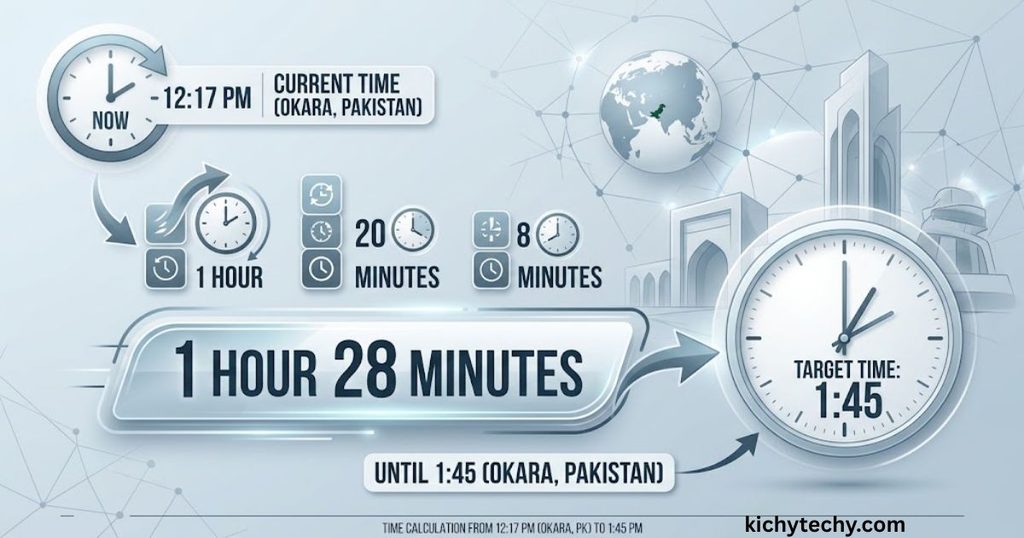
Quick read: Trying to figure out how long until 1:45, whether it’s 1:45 AM or 1:45 PM? This guide walks you through the exact math, gives you ready-made tables for common starting times, and clears up the small mistakes that trip people up when counting down to a specific clock time.
You glance at your phone. It’s 11:20 and you need to know how long until 1:45. Maybe it’s for a meeting, a flight, a nap alarm, or just curiosity because someone asked and you froze. Whatever the reason, the answer is closer than you think, and the math behind it is nothing more than basic subtraction once you know the trick.
Quick Answer
There’s no single fixed answer to “how long until 1:45” because it depends entirely on what time it is right now. But here’s the shortcut:
- Take the current time.
- Subtract it from 1:45 (either 1:45 AM or 1:45 PM, depending on which one you mean).
- If the result is negative, add 12 hours (for the same AM/PM cycle) or roll over to the next day.
For example, if it’s currently 12:00 PM, the time until 1:45 PM is 1 hour and 45 minutes. If it’s currently 11:00 PM, the time until 1:45 AM is 2 hours and 45 minutes. That’s really all there is to it — the rest of this post just breaks it down so you never have to second-guess yourself again.
Why People Search This Topic
Most people who type “how long until 1:45” into Google aren’t doing it for fun. They’re usually in one of these situations:
- Checking how much time is left before a scheduled meeting or class that starts at 1:45.
- Counting down to a flight, train, or bus departure.
- Setting a reminder or alarm and wanting to know the gap before it goes off.
- Trying to plan a nap, workout, or cooking timer that needs to end by 1:45.
- Simply doing quick mental math and wanting to double-check the answer.
Clock-time countdowns feel like they should be instant to calculate, but the moment AM and PM get mixed up, or the hour crosses over midnight or noon, the math gets fuzzy. That’s exactly where most people stumble.
Step-by-Step: How to Calculate Time Until 1:45
Here’s a foolproof method you can use no matter what time it currently is.
Step 1: Identify Your Target — 1:45 AM or 1:45 PM
Before anything else, be clear on which 1:45 you’re counting toward. This single detail changes the entire calculation, so don’t skip it.
Step 2: Convert Both Times to 24-Hour Format

Working in 24-hour (military) time removes the AM/PM guesswork entirely.
- 1:45 AM becomes 01:45
- 1:45 PM becomes 13:45
Convert your current time the same way. For instance, 9:30 PM becomes 21:30.
Step 3: Subtract Current Time From Target Time
Subtract hours and minutes separately.
Example: Current time is 11:15 (11:15 AM), target is 13:45 (1:45 PM).
- Hours: 13 − 11 = 2
- Minutes: 45 − 15 = 30
- Total: 2 hours and 30 minutes
Step 4: Handle Negative Results
If your target time has already passed for the current cycle, you’ll get a negative number. When that happens, add 24 hours to the target time before subtracting.
Example: Current time is 15:00 (3:00 PM), target is 13:45 (1:45 PM, already passed today).
- Add 24 hours to target: 13:45 + 24:00 = 37:45
- Subtract: 37:45 − 15:00 = 22 hours and 45 minutes (until 1:45 PM tomorrow)
Step 5: Double-Check With Minutes
If subtracting minutes gives you a negative number, borrow an hour (60 minutes) from the hour column, just like regular subtraction.
Example: Current time is 12:50, target is 13:45.
- Minutes: 45 − 50 = −5, so borrow: 105 − 50 = 55 minutes, and reduce hours by 1
- Hours: 13 − 12 − 1 = 0
- Total: 0 hours and 55 minutes
Time Until 1:45 PM: Common Starting Points
Use this table to quickly check how much time is left before 1:45 PM from various starting times.
| Current Time | Time Until 1:45 PM |
| 12:00 AM (midnight) | 13 hours 45 minutes |
| 6:00 AM | 7 hours 45 minutes |
| 9:00 AM | 4 hours 45 minutes |
| 10:30 AM | 3 hours 15 minutes |
| 11:45 AM | 2 hours 0 minutes |
| 12:00 PM (noon) | 1 hour 45 minutes |
| 1:00 PM | 45 minutes |
| 1:30 PM | 15 minutes |
| 1:45 PM | 0 minutes (it’s now!) |
| 2:00 PM | 23 hours 45 minutes (next day) |
| 6:00 PM | 19 hours 45 minutes (next day) |
Time Until 1:45 AM: Common Starting Points
If you meant the early-morning version, here’s the same breakdown for 1:45 AM.
| Current Time | Time Until 1:45 AM |
| 12:00 AM (midnight) | 1 hour 45 minutes |
| 1:00 AM | 45 minutes |
| 1:30 AM | 15 minutes |
| 1:45 AM | 0 minutes (it’s now!) |
| 6:00 AM | 19 hours 45 minutes (next day) |
| 12:00 PM (noon) | 13 hours 45 minutes |
| 6:00 PM | 7 hours 45 minutes |
| 9:00 PM | 4 hours 45 minutes |
| 10:30 PM | 3 hours 15 minutes |
| 11:45 PM | 2 hours 0 minutes |
Real-World Application Scenarios
Numbers on a table are useful, but seeing how this plays out in everyday situations makes it click faster.
Scenario 1: Catching a Flight
Your boarding time is 1:45 PM and it’s currently 10:20 AM. Using the subtraction method: 13:45 − 10:20 = 3 hours and 25 minutes. That’s your window to finish packing, get through security, and grab coffee.
Scenario 2: Waking Up From a Nap
You lie down at 12:15 PM and want to be up by 1:45 PM. That’s 13:45 − 12:15 = 1 hour and 30 minutes, so you’d set your alarm for exactly that duration from now.
Scenario 3: A Meeting Starting Soon
It’s 1:20 PM and your meeting starts at 1:45 PM. Subtract: 13:45 − 13:20 = 25 minutes left to prep your notes.
Scenario 4: Overnight Countdown
It’s 9:00 PM and you’re counting down to 1:45 AM for a late-night shift. Since 1:45 AM is technically the next calendar day, add 24 hours to the target (01:45 + 24:00 = 25:45) then subtract: 25:45 − 21:00 = 4 hours and 45 minutes.
Common Mistakes and Misconceptions
Even a simple subtraction problem can go sideways. Here are the slip-ups that cause the most confusion.
- Mixing up AM and PM. Forgetting whether you meant 1:45 in the early morning or the early afternoon is the single biggest source of wrong answers.
- Subtracting minutes incorrectly. Not borrowing an hour when the minute value is smaller than the current time’s minutes leads to negative or nonsensical results.
- Ignoring the day rollover. If the target time has already passed, people often forget to add 24 hours, which throws the whole calculation off by a full day.
- Using 12-hour format for subtraction. Trying to subtract times directly in 12-hour format (like 11:30 AM from 1:45 PM without converting) creates unnecessary confusion. Always convert to 24-hour format first.
- Forgetting time zones. If you’re coordinating with someone in another time zone, “1:45” means something different depending on location. Always confirm whose clock you’re using.
- Rounding too early. Rounding minutes before finishing the calculation (like assuming “about 2 hours” instead of the exact 1 hour 55 minutes) can throw off tight schedules.
Related Calculations and Topics
Once you’ve got the hang of counting down to a specific time, these related skills come in handy too.
| Related Topic | What It Helps With |
| How long until a specific hour (e.g., 3:00, 9:30) | General countdown math for any clock time |
| Converting 12-hour to 24-hour time | Avoiding AM/PM mix-ups |
| Calculating elapsed time between two events | Useful for tracking durations, not just countdowns |
| Time zone conversion | Coordinating meetings or calls across regions |
| Adding/subtracting hours and minutes manually | Core skill behind every countdown calculation |
| Setting a countdown timer or alarm | Practical tool once you know the duration |
Understanding these adjacent concepts makes you faster at solving any “how long until X” question, not just this one.
Conclusion
Figuring out how long until 1:45 really comes down to one thing: knowing your current time and doing a clean subtraction, ideally after converting everything into 24-hour format. Whether you’re counting down to 1:45 AM or 1:45 PM, the process is the same, subtract, borrow minutes if needed, and add 24 hours if the target has already passed for the day. Once you run through it a couple of times, you’ll be able to do this kind of math in your head almost instantly, no calculator or app required.
FAQs
How long until 1:45 PM from right now?
It depends on the current time. Subtract the current time from 13:45 in 24-hour format. For example, from 11:00 AM it’s 2 hours 45 minutes; from 1:00 PM it’s 45 minutes.
How do I know if someone means 1:45 AM or 1:45 PM?
Context usually makes it clear — daytime plans almost always mean PM, while late-night or early-morning references mean AM. When in doubt, ask directly or check the full calendar entry or ticket.
What if 1:45 has already passed today?
Add 24 hours to 1:45 in 24-hour format, then subtract the current time. This gives you the time remaining until 1:45 occurs again tomorrow.
Is there an easy way to calculate this without doing math?
Yes — most phones and computers let you set a countdown timer or add an event at 1:45 and see the live countdown automatically, which removes the need for manual subtraction.
Does the answer change based on time zone?
Yes. “1:45” only means something specific once you attach a time zone to it. If you’re coordinating with someone elsewhere, confirm which time zone the 1:45 refers to before calculating.