


You glanced at the clock, saw a meeting or an alarm set for 3:05, and now you’re doing that mental math thing where you keep losing count. Happens to everyone.
This guide walks you through exactly how to figure out how long until 3:05 — whether that’s 3:05 AM or 3:05 PM — no app required, just a clear method you can use for any time of day.
Quick Answer
The time remaining until 3:05 depends entirely on what time it is right now. There’s no fixed answer because “3:05” isn’t a duration — it’s a destination on the clock. To get your answer:
- Check your current time.
- Subtract it from 3:05 (adding 12 hours to 3:05 if you’re working in 24-hour terms and your current time is later in the day).
- The result is your countdown.
For example, if it’s currently 1:40 PM, you have 1 hour and 25 minutes until 3:05 PM. If it’s 11:00 PM, you have roughly 4 hours and 5 minutes until 3:05 AM the next day. The math is simple once you break it into steps, which is exactly what the rest of this article does.
Why “How Long Until 3:05” Doesn’t Have One Fixed Answer
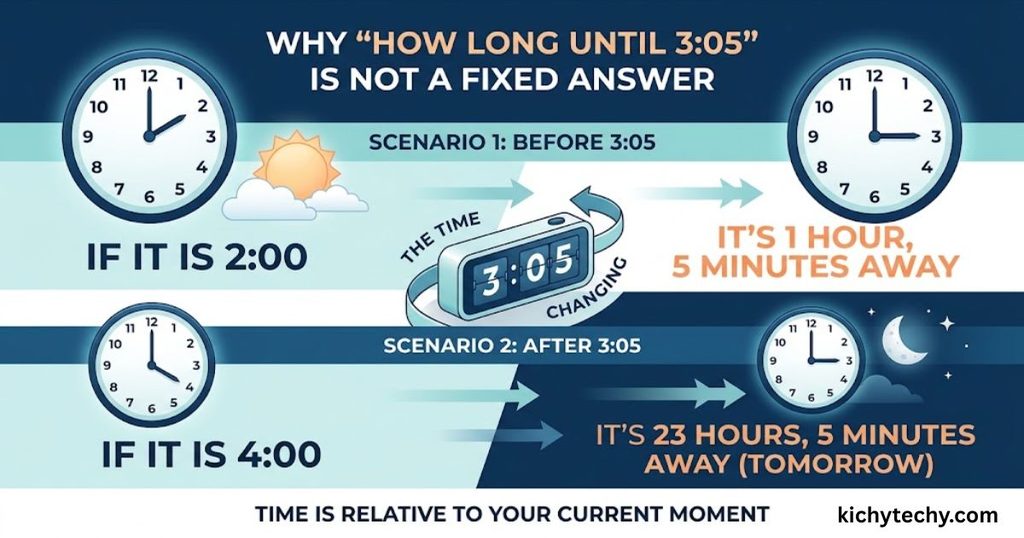
A lot of time-based searches trip people up because they assume there’s a universal answer sitting somewhere online. There isn’t, and here’s why: 3:05 is a fixed point on a 12-hour clock, and it happens twice every single day — once in the morning, once in the afternoon or evening. Your countdown depends on:
- Your current time (obviously the biggest factor)
- Whether you mean 3:05 AM or 3:05 PM
- Your time zone, if you’re coordinating with someone elsewhere
This is different from a question like “how many minutes are in an hour,” which always has the same answer. A countdown to a specific clock time is a moving target — it shrinks every second, which is exactly why people keep searching it throughout the day instead of just checking once.
Step-by-Step: How to Calculate Time Until 3:05
Here’s the method, broken down so you can do it in your head in under ten seconds once you’ve practiced it a couple of times.
Step 1: Note your current time
Look at your phone, computer, or watch. Write it down mentally as hours and minutes — for example, 2:12 PM.
Step 2: Confirm AM or PM target
Decide which 3:05 you’re aiming for. If it’s currently morning, you’re probably counting toward 3:05 PM. If it’s evening or night, you’re likely counting toward 3:05 AM the next day.
Step 3: Subtract the hours first
Take the target hour and subtract your current hour. Using 2:12 PM as an example, going to 3:05 PM:
- 3 (target hour) minus 2 (current hour) = 1 hour difference (before adjusting minutes)
Step 4: Handle the minutes
Now compare the minutes. Your current minute is 12, and the target minute is 05. Since 05 is less than 12, you can’t cleanly subtract — so borrow an hour and convert it to 60 minutes:
- 1 hour becomes 0 hours + 60 minutes
- 60 + 05 (target minutes) − 12 (current minutes) = 53 minutes
So the full answer: 0 hours and 53 minutes until 3:05 PM.
Step 5: Double-check with a simpler gut-check
A fast sanity check: round your current time and the target time to the nearest five minutes, subtract roughly, then fine-tune. If it “feels” close to your calculated answer, you’ve probably got it right.
Time Until 3:05 PM — Common Starting Points
Here’s a table showing the countdown from several common current times to 3:05 PM, so you can find something close to your situation right now.
| Current Time | Time Until 3:05 PM |
| 12:00 PM | 3 hours 5 minutes |
| 12:30 PM | 2 hours 35 minutes |
| 1:00 PM | 2 hours 5 minutes |
| 1:30 PM | 1 hour 35 minutes |
| 2:00 PM | 1 hour 5 minutes |
| 2:30 PM | 35 minutes |
| 2:45 PM | 20 minutes |
| 3:00 PM | 5 minutes |
| 3:05 PM | 0 minutes (it’s here) |
Time Until 3:05 AM — Common Starting Points
If you’re a night owl or working a late shift, here’s the same breakdown for 3:05 AM.
| Current Time | Time Until 3:05 AM |
| 9:00 PM | 6 hours 5 minutes |
| 10:00 PM | 5 hours 5 minutes |
| 11:00 PM | 4 hours 5 minutes |
| 12:00 AM (midnight) | 3 hours 5 minutes |
| 1:00 AM | 2 hours 5 minutes |
| 2:00 AM | 1 hour 5 minutes |
| 2:45 AM | 20 minutes |
| 3:00 AM | 5 minutes |
Real-World Scenarios Where This Question Comes Up
People don’t usually search this out of idle curiosity. It’s almost always tied to something practical.
Catching a meeting or class. You’ve got a 3:05 call and you’re trying to figure out if you have time to grab coffee first.
Setting or checking an alarm. Someone sets an alarm for 3:05 AM to catch an early flight and wants to know how much sleep they’re actually getting.
Cooking or baking timers. A recipe says “pull it out at 3:05,” and you’re mid-task with flour on your hands, not wanting to do math.
Live events or broadcasts. A show, stream, or sports match starts at 3:05, and you want a heads-up on when to tune in.
Medication or task reminders. Some routines are scheduled to the exact minute, especially medical dosing schedules.
Converting the Countdown Into Other Units
Sometimes “hours and minutes” isn’t the most useful format. Here’s how to convert a countdown into other common units, using a 1 hour 5 minute countdown as the working example.
| Unit | Conversion | Result |
| Minutes only | (1 × 60) + 5 | 65 minutes |
| Seconds only | 65 × 60 | 3,900 seconds |
| Decimal hours | 1 + (5 ÷ 60) | 1.083 hours |
| Fraction of a day | 65 ÷ 1440 | ≈ 0.045 of a day |
This kind of conversion is handy if you’re logging time for work, building a countdown timer in code, or just want a different way to picture the wait.
Common Mistakes People Make With This Calculation
Mixing up AM and PM. This is by far the most common slip. If you’re currently at 4:00 PM and think “3:05 is coming up,” you’ve actually already passed it — you’re now counting toward tomorrow’s 3:05 AM or the next day’s 3:05 PM, not backward.
Forgetting to borrow the hour. When your current minutes are higher than the target minutes (like 2:40 PM counting to 3:05 PM), a lot of people just subtract 40 from 05 and get confused by a negative number instead of borrowing 60 minutes from the hour column.
Ignoring time zones during calls or coordination. If you’re scheduling something with someone in another region, “3:05” on your clock and “3:05” on theirs could be hours apart. Always clarify which time zone the 3:05 refers to.
Assuming 24-hour and 12-hour clocks match up automatically. In 24-hour (military) time, 3:05 could mean 03:05 (early morning) or 15:05 (afternoon). If a schedule uses 24-hour format, double-check which one you’re reading.
Not accounting for daylight saving changes. On the rare days when clocks shift forward or back, your countdown math can be thrown off by exactly one hour. Worth checking the calendar if your calculation feels off around those transition dates.
Why People Search This Topic
Honestly, it’s one of the most human questions there is. We don’t naturally think in exact countdowns — we think in “soon,” “a while,” or “not yet.” Typing “how long until 3:05” into a search bar is faster than doing subtraction, especially when you’re distracted, tired, or just want a quick confirmation that your own math was right.
It also spikes around specific moments: people waiting for a specific class period to end, a scheduled call, a delivery window, or a show that starts at an odd time like 3:05 instead of a round number like 3:00. Odd, specific times like this usually come from real schedules — TV listings, transit timetables, appointment slots — which is why the question feels so oddly specific and personal every time someone types it.
Related Time Calculations You Might Also Need
- How long until midnight — useful for end-of-day deadlines
- How many hours until a specific date — for countdowns spanning days, not just hours
- Time zone converters — for coordinating a 3:05 meeting across regions
- Minutes-to-decimal-hours conversion — common in payroll and time-tracking
- Countdown timers for recurring daily events — for anyone who needs this calculation every day, not just once
If you find yourself doing this kind of math often, it might be worth bookmarking a simple online countdown tool or setting a phone alarm instead of recalculating by hand each time.
Conclusion
There’s no single number that answers “how long until 3:05” because it depends entirely on where you’re starting from and whether you mean morning or afternoon. But once you know the method — subtract the hours, borrow a full hour when the minutes don’t divide evenly, and double-check AM versus PM — you can work out the answer for any current time in seconds. Use the tables above as a quick reference, or run through the five-step method the next time a random clock time catches you off guard.
Frequently Asked Questions
How do I quickly calculate how long until 3:05 PM from any time?
Subtract your current time from 3:05 PM. If your current minutes are higher than 05, borrow 60 minutes from the hour column before subtracting. For example, from 2:20 PM, borrow to get 1 hour and 60 minutes, then subtract 20 minutes to land on 45 minutes remaining.
Is 3:05 in the morning or afternoon?
It can be either — that’s the whole reason there’s no single fixed answer. 3:05 AM is in the early morning hours, while 3:05 PM falls in the mid-afternoon. Always confirm which one you’re working toward before calculating.
How many minutes are there between now and 3:05 if it’s currently 2:45?
If it’s 2:45 PM and you’re counting to 3:05 PM, that’s 20 minutes away. If it’s 2:45 AM counting to 3:05 AM, it’s also 20 minutes away, since the minute math is identical regardless of AM or PM.
Does daylight saving time affect the countdown to 3:05?
Yes, but only on the two days each year when clocks change. On a “spring forward” day, an hour gets skipped, and on a “fall back” day, an hour repeats. Outside of those two days, daylight saving has no effect on your calculation.
What’s the fastest way to find how long until 3:05 without doing math?
Set a phone alarm or countdown timer for 3:05 and let your device handle it. If you want the number itself rather than just a notification, use an online time calculator and enter your current time alongside the 3:05 target.